In event services — weddings, corporate seminars, catered cocktails, DJ nights — one question returns at every signature: should you request a deposit or earnest money? That vocabulary choice is not trivial. It determines what you can keep if the client cancels, what you must refund if you decline the job, and how solid your file stands before a French or European court.
This guide is for caterers, wedding planners, DJs, photographers, and independent entertainers who collect deposits months before the event. We detail the legal framework, proven cancellation clauses, schedules by trade, and how to formalise quotes and contracts. The stakes go beyond accounting: mislabelling an upfront payment can sometimes cost you in litigation what you thought you had secured commercially.
Every year, event providers discover the hard way that the term on their quote — "earnest money," "deposit," sometimes all three on different documents — guides how a judge interprets the case. The amount may be identical; the consequences on cancellation are not. This guide aims to clarify those distinctions before a client postpones their wedding or a supplier drops you at D-15.
Deposit vs earnest money: the legal framework in France
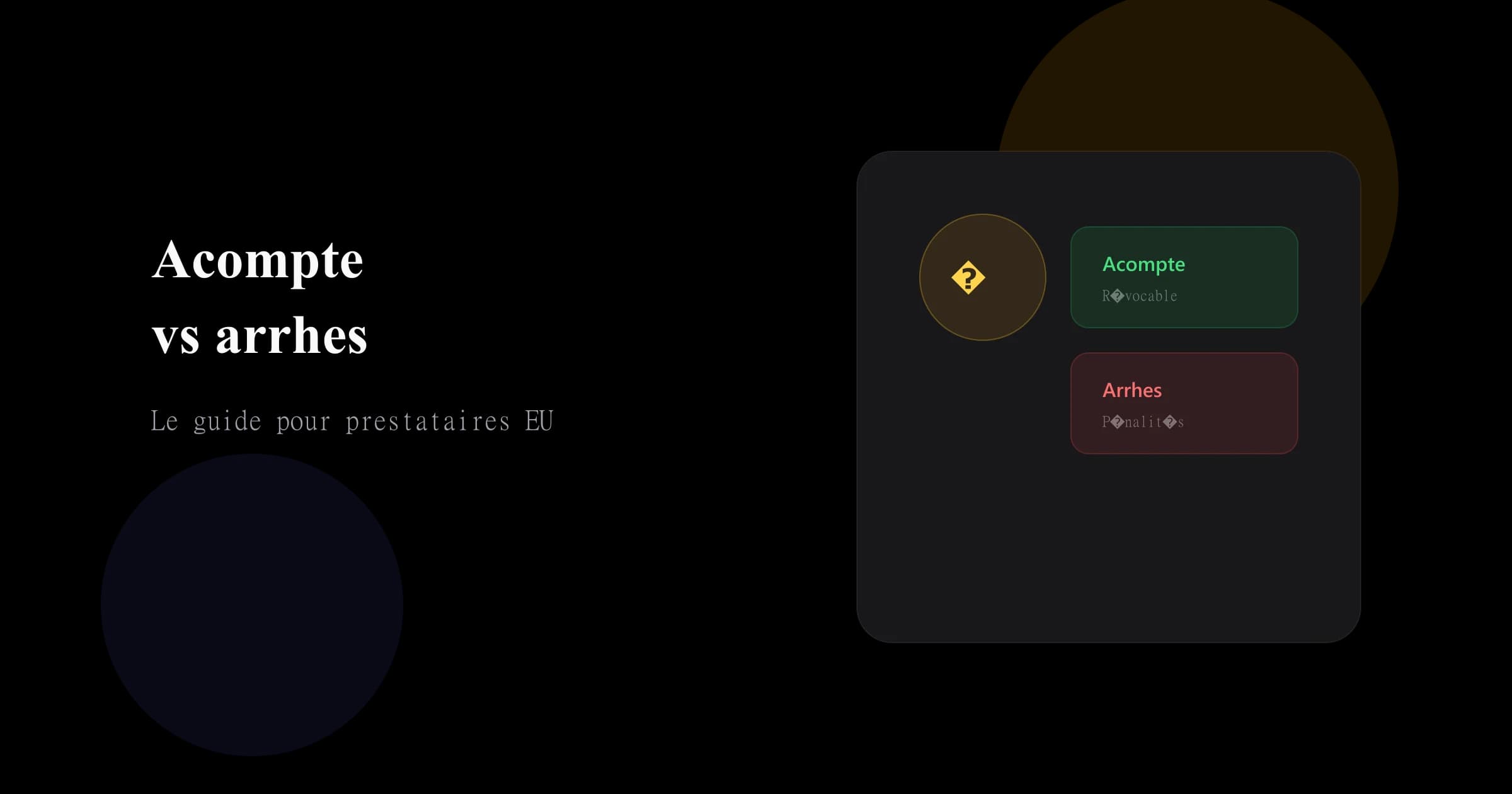
French law clearly distinguishes two regimes for upfront payments. A deposit is an advance on the final price of the service. It offsets the total amount due and falls under general contract law, supplemented by your contractual clauses. If the client cancels, you generally keep the deposit when your contract provides for it in proportion to prejudice suffered — blocked date, preparation hours, supplier commitments.
Earnest money, governed by Article 1590 and following of the French Civil Code, is part of the price paid when the contract is concluded. It materialises commitment from both parties and triggers a specific regime: the client who withdraws forfeits it; the provider who backs out must return double. That deterrent mechanism suits some sectors — real estate, for example — but exposes event providers to asymmetric risk if misunderstood. If you cancel because no replacement DJ can be found, the earnest money regime obliges you to return double what you received.
In practice, the vast majority of event providers use a clearly labelled deposit, supplemented by cancellation conditions adapted to their trade and booking calendar. Using the word "earnest money" on a wedding contract often reflects copy-paste from online templates, not a deliberate legal choice. Disputes almost never turn on the amount itself, but on ambiguous labelling.
Outside France, regimes vary: deposit, earnest money, Anzahlung. If you work with cross-border clients, specify applicable law in your T&Cs and adapt clauses to local consumer requirements. For intra-EU B2B services, contractual freedom is broader, but transparency on the nature of the payment remains essential. A German or Belgian client reading "earnest money" without understanding the French Civil Code burden deserves a plain-language explanation.
Invoicing also differs by regime. A deposit triggers a deposit invoice at collection, then a balance invoice. Earnest money, when genuinely qualified as such, follows partial price logic due at order. Your accountant must validate the wording, especially if you are VAT-registered and the service spans several months.
Courts first examine party intention as it appears from signed documents. A contract speaking of a "non-refundable deposit if the client cancels less than sixty days out" will be read under penalty clause and Article 1231-5 rules, not strict earnest money law. Conversely, a document repeatedly using "earnest money" without parallel cancellation clauses may be qualified as such, with consequences for the provider who defaults.
Proportionality is the central criterion. Keeping one hundred percent of the total because the client cancels one hundred twenty days before a wedding for which you only invested a few planning hours may be judged excessive. Keeping thirty percent at signature when you blocked a peak-season date and turned down two other clients is generally defensible. Document your hours and commitments; in a dispute, proof of real prejudice strengthens your position.
Why deposits dominate in event services
A wedding, gala, or corporate seminar mobilises resources long in advance: venue booking, non-cancellable caterer purchases, calendar blocking, subcontracted photographer or DJ. The deposit serves three essential economic functions. It secures your cash flow ahead of the event day, when costs are already committed or imminent. It filters unserious prospects who would block a date without real intent. It covers partial prejudice if the client cancels late, without tipping into the penalising earnest money regime for the provider.
A well-calibrated deposit is not a commercial pressure tool — it is common sense aligning client and provider interests on an event planned months ahead.
Typical amounts observed on the French market in 2026 vary by trade. A caterer or reception venue typically requests thirty to fifty percent at signature, balance thirty to sixty days before the event. A wedding planner practises twenty-five to forty percent at signature, with possible interim instalments on twelve- to eighteen-month engagements. A DJ, photographer, or videographer sits around thirty percent at signature and balance fifteen to thirty days before. An MC or entertainer, depending on duration and preparation, asks twenty to thirty percent.
These ranges are not legal obligations; they are market benchmarks. Setting them too low exposes you to non-payment and competition from uncommitted clients. Setting them too high without justification frightens couples already stretched by wedding budgets. Balance comes from clearly stating what the deposit funds: date blocking, planning launch, supplier bookings, file fees.
A solid contractual file rests on simple principles: identical "deposit" labelling everywhere, tiered dated cancellation clause, amounts proportionate to real prejudice, contract signed before any collection. Conversely, mixing deposit, earnest money, and "deposit" in English on the same file, imposing one hundred percent penalty without justification, collecting before signature, or diverging conditions between quote and T&Cs favours the client in litigation.
Cancellation clauses: drafting solid terms
Cancellation clauses are the core of your financial protection. They must be readable, dated, and proportionate to prejudice you actually suffer — committed purchases, lost dates, non-billable preparation hours. A judge may reduce a manifestly excessive penalty; your clause must therefore set clear time thresholds, specify what is retained at each threshold, mention non-refundable file fees where relevant, and provide postponement distinct from pure cancellation.
A typical formulation for a wedding planner might state that a thirty percent deposit is due at signature; if the client cancels more than ninety days before the event, the deposit remains as compensation for preparation and date blocking; between ninety and thirty days, fifty percent of the VAT-inclusive total remains due; below thirty days, the full amount remains due; and any cancellation must be notified in writing. That structure holds because it reflects increasing commitment intensity over time.
Adapt severity to your trade. A caterer orders perishables, mobilises a brigade, and blocks stock; clauses are generally stricter than a consultant who only committed intellectual time. More than six months before the event, retaining the deposit alone — twenty to thirty percent — is often accepted. Between three and six months, fifty percent of the total may remain due. Below three months, eighty to one hundred percent, or full amount plus documented costs below fifteen days.
The wedding planner works over six to eighteen months with tiered deposits, intermediate payments, and balance. To structure a compliant quote, see our guide on how to write a compliant wedding planner quote. A DJ or photographer mainly suffers a missed opportunity — blocked date — and a few preparation hours; standard clauses, deposit retained beyond sixty days and full balance below fifteen days, often suffice.
Provide a postponement clause: one free reschedule subject to availability, then reorganisation fees. Without a dedicated clause, a client who postpones their wedding may dispute what happens to the deposit. Since 2020, clients also expect explicit force majeure language: pandemic, exceptional weather, administrative venue closure. Define whether you offer postponement, credit, or partial refund according to supplier constraints.
Copy-pasting T&Cs found online without adapting to your trade is the most frequent drafting mistake. A clause designed for a five-hundred-cover caterer does not suit a solo photographer. One hundred percent penalties without link to real prejudice are regularly reduced by courts. Missing postponement clauses and omitted force majeure create situations where neither you nor the client knows which rights apply — the commercial relationship weakens even without a lawsuit.
Require written notification for any cancellation. A voice message or corridor conversation is not enough to trigger your contractual thresholds. Specify the email address or registered post route. That formality protects both parties: the client knows how to proceed; you know when the notice period started.
Payment schedules: caterer, wedding planner and DJ
A coherent schedule reassures the client and smooths your cash flow. It translates into concrete dates what your cancellation clause protects in law. For a caterer or event catering service, common practice is forty to fifty percent at signature, thirty percent sixty days before the event, balance thirty days before. On an €8,000 VAT-inclusive caterer quote, that means €4,000 at signature, €2,400 at D-60, €1,600 at D-30. Those amounts cover purchases, brigade mobilisation, and financial closure before service.
The wedding planner often follows a different grid: thirty percent at signature to secure date and framing, thirty percent one hundred twenty days before to fund vendor bookings, balance thirty days before finalisation and day-of coordination. They may add a non-refundable "file fee" line — €150 to €300 — distinct from the deposit, clearly identified on the quote. That distinction prevents the couple treating the deposit as a simply reversible option.
For a DJ, photographer, or videographer, simplicity wins: thirty percent at signature to block the date, balance fifteen to thirty days before service. For summer events — June to September — many professionals require forty percent at signature and balance at D-30 rather than D-15 to avoid last-minute non-payment. Peak season concentrates risk; the schedule must reflect it.
Each instalment must be stated as percentage and VAT-inclusive euros on the quote. "Balance before the event" without relative date is too vague. "Balance of €4,200 including VAT due thirty days before 14 June 2026" is enforceable. Link each payment to a milestone the client understands: signature, D-60, D-30, or delivery of high-resolution files for a photographer.
Some wedding venue or rental contracts still use "earnest money" by real-estate habit. If you are not a lawyer, stick to deposit with adapted cancellation clauses and have your T&Cs reviewed by a legal professional before peak season. The cost of legal review is negligible compared with litigating a multi-thousand-euro file.
Formalising the deposit in quote and contract
Written formalisation is your best insurance. Each document must align without contradiction. Start by stating the deposit explicitly: percentage and VAT-inclusive amount, never "deposit to be agreed." Date each instalment by linking it to a milestone — signature, D-60, D-30 — rather than a fixed absolute date at drafting if the event may still move.
Copy cancellation clauses onto both quote and service contract. A reference to T&Cs is acceptable if they are annexed and signed. Sign before collecting: no payment before quote or contract signature. That is good commercial practice and a seriousness signal for the client. Invoice immediately on collection: deposit invoice first, balance invoice on final payment, same terminology everywhere.
Verify full identity, SIRET, VAT, and contact details on every document. Confirm HT and VAT-inclusive totals are consistent across lines, subtotal, and grand total. Set quote validity — thirty days standard. Prepare a contract template ready to send on acceptance, not to draft in a panic on Friday evening when the client finally signs.
To avoid administrative mistakes costing hours weekly — forgotten follow-ups, scattered quotes, unreconciled deposits — see also five freelance admin mistakes in 2026. Correct legal labelling on a quote lost in Gmail protects nobody.
The deposit is subject to VAT at collection date if the service is identifiable. State VAT on the deposit invoice and offset it correctly on the balance invoice. Mixed services — caterer plus equipment hire, wedding planner plus decoration sales — complicate allocation; your accountant remains the reference. When in doubt, ask upfront rather than face adjustment at year-end.
For destination weddings or European seminars, fix contract currency — euro is recommended for a French provider — and applicable exchange date if the client pays from abroad. Avoid ambiguity on deposit amount in multiple currencies. Monetary clarity prevents tense discussions when the balance arrives.
Automating the deposit journey without losing legal control
Configuring your deposit once in ClientFlow, then reusing it on every quote, turns an artisan process into a professional flow without giving up your clauses. The ideal client journey: quote review in the client portal, questions via integrated messaging, e-signature of the contract via trade templates, deposit payment by card via Stripe Connect, automatic balance invoice with scheduled reminders.
A quote sent by email alone gets lost, cannot take immediate payment, and stretches the gap between verbal agreement and collection. Providers adopting a client portal typically cut payment delay by two-thirds. To understand client expectations on that experience, read what clients really expect from a client portal. Automation does not replace drafting your legal clauses; it ensures the configured amount is what gets collected, invoiced, and attached to the right file.
Each payment links to the client file: no more end-of-month doubt about "did the deposit go through?" Your accountant receives clean exports; you keep full history of quote, contract, invoice, and collection. That traceability strengthens your file if a client disputes a payment six months later. You produce the deposit invoice, collection date, and signed contract — not an isolated Stripe screenshot.
Bank transfer remains relevant for large B2B amounts or corporate clients requiring bank details. Offer it as an alternative, but keep card as default for couples and SMEs who want to pay immediately. Average delay between verbal yes and received transfer often exceeds ten days; card compresses that window to minutes.
Special cases: postponement, substitution and force majeure
Without a dedicated clause, a client who postpones their wedding may dispute what happens to the deposit. Specify: one free reschedule, reorganisation fees beyond that, or conversion to credit valid twelve months. Postponement is not cancellation; mixing both regimes in one paragraph blurs reading and favours consumer-friendly interpretation.
In corporate — seminar, product launch — the original client may ask to assign their slot to a subsidiary or partner. Provide an approval clause: you are not obliged to accept a third party without written consent. Deposit paid by Company A does not automatically apply to an event reorganised by Company B without your validation.
Post-2020 force majeure is no longer limited to classic natural disasters. Pandemic, administrative closure, impossible venue access: define your policy. Free reschedule if available? Twelve-month credit? Partial refund if suppliers refund a fraction? Absence of clause does not automatically shield you; it leaves room for emotional negotiation where nobody wins.
Summary: building a consistent file end to end
Choose the deposit regime, unless a legal professional validates a specific case. Draft tiered proportionate cancellation clauses. Adapt the schedule to your trade — caterer, wedding, DJ — without copying an unsuitable template. Harmonise quote, contract, and invoices word for word on amounts, dates, and "deposit" labelling. Deploy a client portal with online payment to reduce delay between signature and collection. Have your T&Cs reviewed before peak season.
A well-formalised deposit protects your business without damaging the client relationship. Clarity from the first quote is a professionalism signal — especially when the client compares three providers on €3,000-plus amounts.Structure your deposits once, reuse them on every quote. French contract law offers sufficient tools for event providers who take care to use them correctly. The word matters as much as the amount; the schedule as much as the cancellation clause; the deposit invoice as much as the received transfer. Each link strengthens the others.
Try ClientFlow free for 14 days — client portal, trade contracts and Stripe Connect payments included.