Admin is not why you became independent — and yet in 2026 it can steal five to ten hours a week if your tools do not talk to each other. Excel in one tab, quotes in Gmail, deposits on Stripe, briefs on WhatsApp: fragmentation is no longer a "minor hassle"; it is a direct brake on revenue.
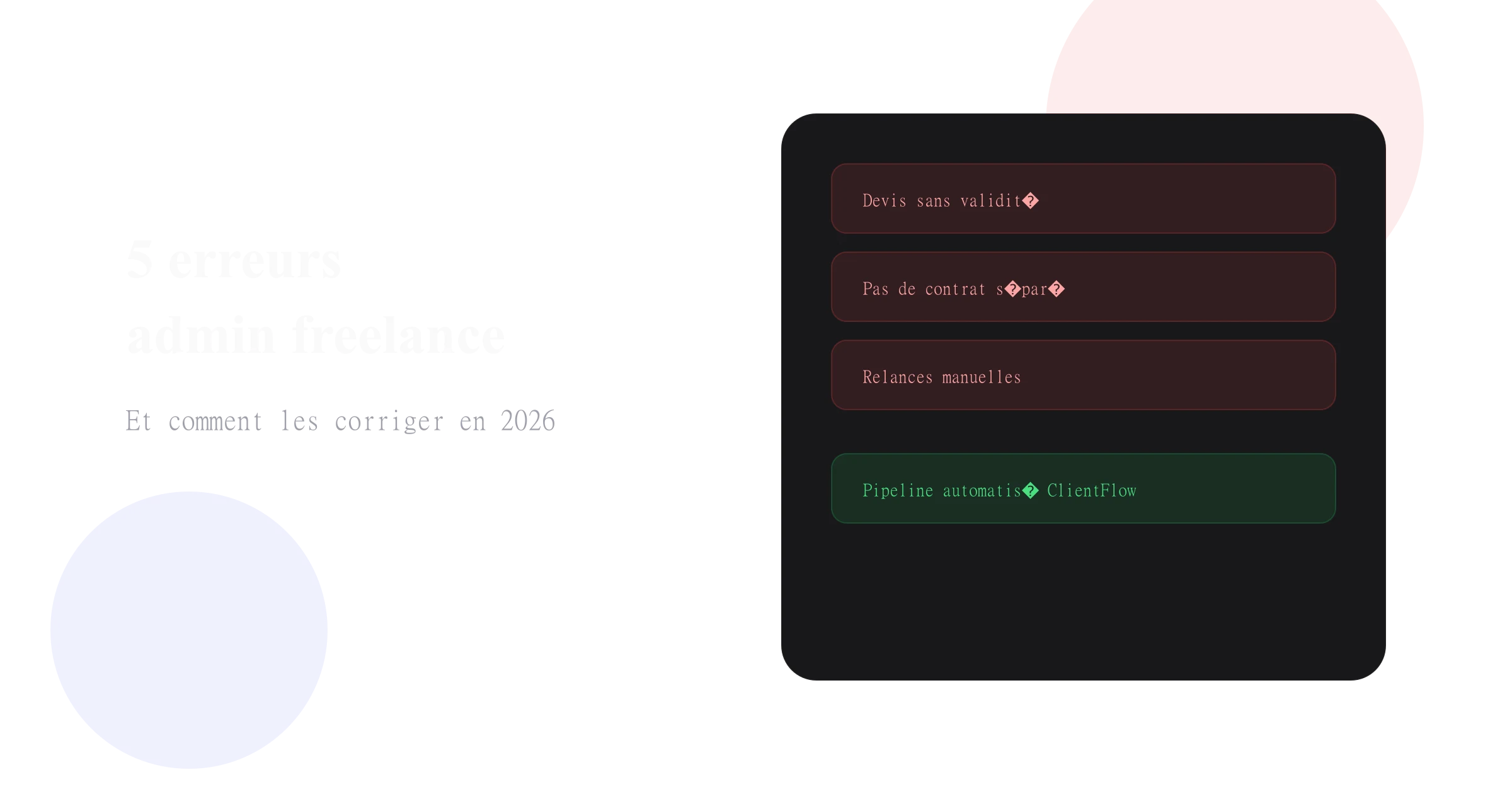
Every week we speak with wedding planners, photographers, consultants, designers, and micro-agencies who excel on delivery but exhaust themselves on admin. Symptoms look the same: quotes that linger, unreconciled deposits, follow-ups forgotten during rush periods, stressful month-end accounting. This guide details the five most common administrative mistakes among freelancers in 2026, with actionable fixes. The goal is not to sell a miracle method, but to name precisely what costs you time and revenue — then show how to fix it without rebuilding your entire business overnight.
Poorly organised admin produces invisible costs. Five ten-minute searches per day is more than thirty unpaid hours per year. At €80 per hour, that is €2,400 of lost productivity — without counting unconverted quotes for lack of follow-up or deposits forgotten at month-end. These figures are not theoretical; they emerge from field feedback we collect from European independents who migrated to a unified flow. The recurring finding: the problem is rarely craft skill, it is the absence of a single source of truth for the client journey. Every extra tool added without links multiplies oversights; every oversight costs a missed follow-up, an unreconciled deposit, or a late invoice.
Why 2026 changes the game for freelance admin
The context has shifted. Your clients now compare your journey to online banking, B2B SaaS, or a marketplace — not only to the last provider they found on Instagram. A quote sent by email with no signature or immediate payment option feels archaic, even when your creative work is excellent. That expectation is not reserved for corporate clients; couples planning a wedding, parents booking a family shoot, and SME owners share the same impatience with administrative friction.
Meanwhile, regulatory and accounting pressure in Europe — VAT, e-invoicing, payment traceability — makes "gut-feel management" increasingly risky. Independents who structure their client pipeline from the first enquiry gain an edge — not only in productivity, but in commercial credibility. A photographer who invoices cleanly from the deposit reassures as much as a consultant who delivers an impeccable deliverable. Admin has become a seriousness signal.
The micro-agency — two to five people, several parallel files, sometimes several trades — amplifies these stakes. When three freelancers share an Excel spreadsheet "updated when we have time," nobody knows which version is authoritative. Follow-ups fall through cracks; a client receives two contradictory emails. Centralising client tracking is no longer a luxury for fifty-person agencies; it is a survival condition for anyone who wants to scale without hiring a full-time assistant.
In 2026, the question is no longer "do I need a tool?" but "which link in my chain breaks most often?" Identify that link, fix it first, then move on. A seven-day migration plan described later beats a perfect overhaul never launched.
Mistake 1: juggling Excel, Gmail and WhatsApp
This is the most widespread mistake — and the most insidious, because it "works" until it breaks. Every client has their WhatsApp thread, homemade tracking spreadsheet, and attachments lost somewhere in the inbox. Typical result: fifteen minutes lost finding "quote version 3," a deposit received on Stripe but not reconciled to the right file, a client brief forgotten in a four-minute voice note, a signed contract version missing when a dispute arises.
The problem is not the tool itself. Excel is an excellent spreadsheet. Gmail is good email. WhatsApp is handy for a quick exchange. The problem is no single source of truth: none of these tools knows that quote D-2026-047 links to the Stripe payment and the brief received Tuesday evening. When you search for information, you query three systems; when you forget to update one, the others lie by omission.
Centralisation does not mean abandoning WhatsApp for informal chat. It means contractual decisions, validated briefs, and payments live in one client file with full history. Quotes, contract, messages, and payments in one place; instant search by name, amount, or status; accounting export in a few clicks at period end. Conversely, a spreadsheet updated "when we have time," attachments scattered across three inboxes, and contractual decisions buried in WhatsApp produce a month-end where you manually reconstruct collected revenue.
Solution: centralise client tracking in a tool built for the full journey — from first enquiry to final payment. The ClientFlow Quotes module lets you create, send, and track proposals from a reusable catalogue, with every version archived in the client file. No more hunting for "quote_v3_final_really_final.pdf." For event services where payment schedules are critical, also read our guide on deposit vs earnest money — wrong labelling can cost dearly on cancellation.
Migrate without abandoning everything at once. Start with your three most active files. Recreate or import the current quote, open the client portal, archive essential documents. In a half-day spread over a week, you will have tested the flow on real situations without paralysing ongoing work.
Mistake 2: sending quotes without a client portal
A PDF by email worked in 2015. In 2026, clients compare your experience to smooth journeys: online review, e-signature, card payment in two clicks. A quote sent only by email gets lost in the inbox or lands in spam. It allows neither signature nor immediate payment. It generates manual follow-ups — "did you receive my quote?" — and back-and-forth on questions already answered in the document.
A client hesitating between three providers does not always choose the cheapest; they choose whoever makes the decision easiest. The first to offer signature and payment in one smooth journey often wins the file, even at a slightly higher rate. The client portal turns a passive document into an active journey. Your client clicks a secure link, reviews detail, asks questions via integrated messaging, signs the contract, and pays the deposit — without creating an account or remembering a password.
Independents who adopt a client portal report payment delay cut by a third on average between verbal agreement and collected deposit. On a €3,000 service, the difference between collecting within twenty-four hours or ten days changes your monthly cash flow. Classic email flow — PDF send, questions, bank details, transfer — takes five to ten days on average. Portal flow — link, review, signature, card payment — counts in hours to forty-eight hours.
Solution: activate the ClientFlow client portal on your next quote send. The client accesses their file via a unique link, signs via eIDAS-compliant Yousign, and pays by card via Stripe Connect. For more on client expectations in 2026, read our article on the client portal and what clients really expect. Also see how to write a compliant wedding planner quote if you work in events — a poorly structured quote delays the entire portal chain.
The PDF still matters: the couple or director wants a downloadable archive. Send both — PDF plus portal link — rather than choosing one or the other. The PDF reassures; the portal converts.
Mistake 3: forgetting to follow up unsigned quotes
An unanswered quote is revenue in limbo. Yet without a system, follow-ups slip — especially when you are on assignment, in creative rush, or travelling. You tell yourself "I'll follow up tomorrow," and tomorrow becomes never. Consequences are concrete: lukewarm prospects who sign elsewhere for lack of contact, a pipeline artificially inflated by dead quotes, no way to distinguish "not yet" from "lost," no visibility on your real conversion rate.
Before automatic follow-ups, many independents lost roughly one quote in four — not because the client refused, but because they forgot to follow up at the right moment. It was not a sales skill problem; it was organisation. Following up the next day can feel pushy; waiting three weeks is too late. The sweet spot for most B2B and event services sits between D+3 and D+7 for the first follow-up, with a service-oriented tone rather than a blunt reminder.
Solution: configure ClientFlow automations at D+3, D+7, and D+14. The system sends follow-ups on your behalf, with your tone and signature. You keep control of content; the tool guarantees consistency. Each follow-up is traced in the client file — no more "did I already follow up?" Offer an option, a call slot, or clarification rather than a bare reminder; a well-calibrated follow-up is perceived as service, not harassment.
For wedding planners sending complex quotes in peak season, the combination of structured quote plus automatic follow-ups changes outcomes. A clear quote reduces questions; a D+3 follow-up unblocks the undecided; a D+14 follow-up with "lost" status cleans your pipeline so you do not believe in fictitious revenue.
Mistake 4: collecting payments without proper invoicing
Deposit received on Stripe, forgotten balance, miscalculated VAT, invoice issued late for accounting… This mistake hits beginners and experienced independents who juggle several payment tools. Month-end equals manual export to the accountant, with gaps. VAT to reconstruct from scattered collections. Client asking for an invoice you have not drafted. Impossible to know who paid what without opening Stripe, the bank, and Excel.
Every payment structured correctly from the start saves one to two hours per month at accounting close — and reduces VAT error or duplicate invoicing risk. The key is linking each collection to an accounting document at payment time, not six weeks later. A deposit must generate a deposit invoice; the balance, a balance invoice. HT, VAT-inclusive amounts, and VAT must be consistent across quote, contract, and invoice.
The quote sets the commercial frame: services, options, schedule. The deposit invoice, issued on collection, materialises the first payment with VAT and quote reference. The balance invoice closes the service by deducting invoiced deposit. Period-end accounting export synthesises everything for your accountant. If one link is missing, you reconstruct the story by hand — and almost always forget a collection or a VAT line.
Solution: configure deposit as percentage directly on the quote, then let ClientFlow Payments handle Stripe Connect collection and automatic invoice generation. Each payment links to the client file: no more end-of-month doubt about "did the deposit go through?" ClientFlow does not replace your accountant; it supplies clean exports so tax validation and filings stay in professional hands.
Mistake 5: running the business without reliable numbers
Without reliable visibility on pipeline and collected revenue, you navigate blind. You feel a "busy" month without knowing if revenue will follow. You accept assignments without seeing your calendar is already saturated. You follow up by gut instead of prioritising high-stakes files. Running a freelance business without indicators is driving at night without headlights: you move forward until an unpaid invoice, cash gap, or bad pricing decision brutally reminds you of reality.
Questions every freelancer should answer in ten seconds: how many quotes await signature this week? What is my conversion rate this quarter? Which clients have unpaid balance? What is collected vs invoiced revenue this month? If you open three tools and scribble on a sticky note to answer, you are in mistake 5 — even if delivery goes well.
Solution: review ClientFlow reports weekly — quote conversion, unpaid amounts, monthly revenue, pipeline by status. Ten minutes Monday morning suffices to prioritise follow-ups, spot bottlenecks, and adjust load. Numbers do not replace craft intuition; they complement it. Ten minutes weekly discipline on reports beats a poorly targeted prospecting day.
Ten minutes of weekly discipline on your reports beats a poorly targeted prospecting day.A pipeline inflated with quotes "pending" for six weeks gives false security. Mark dead files, follow up lukewarm ones, celebrate signed ones — but look at numbers as they are. It is uncomfortable once; it is liberating afterwards.
Seven-day action plan: fix without stopping everything
No need to migrate everything overnight. Here is a realistic plan to fix all five mistakes without blocking ongoing work. Day 1: audit current tools — mail, Excel, Stripe, Drive, WhatsApp, Notion. Note for each tool what information lives there, who updates it, how many minutes per week you lose searching. Day 2: identify friction point number one. For most freelancers, it is forgotten follow-ups or month-end invoicing.
Day 3: migrate three active clients. Create one file per client in ClientFlow, import or recreate the current quote. Do not chase perfection; test the flow on real files. Day 4: configure a reusable quote template — mandatory fields, modular options, payment schedule. Standardise once, reuse on every send via the Quotes module. Day 5: activate the client portal on the next quote sent. Observe delay between send and signature; you will probably not return to PDF-only.
Day 6: schedule automatic follow-ups D+3, D+7, D+14 via Automations. Personalise the message. Day 7: open Reports, identify pending quotes and unpaid amounts, adjust next week's priorities. Block a recurring slot — ten minutes per week — for this review.
Before saying "done," verify each active client has one file with quote, contract, and payment history; the next quote goes via client portal, not attachment only; follow-ups are active; each deposit automatically generates a compliant invoice; your accountant knows where to find period-end export.
What changes when freelancers fix these mistakes
Independents who move from a stack of tools to a unified flow — enquiry, quote, signature, payment, invoicing — report three recurring benefits. Time recovered for production and prospecting, not file hunting. More predictable revenue through systematic follow-ups and faster collections. Stronger professional image from first contact — decisive when the client compares several providers.
Replacing four tools with one flow is no longer a luxury in 2026. It is a competitiveness condition for micro-agencies and freelancers who want to scale without hiring a full-time assistant. Excel remains your ally for modelling your year; it is not meant to be your CRM. WhatsApp stays handy for a quick exchange; it is not meant to carry signed contracts. The boundary is not "all digital" vs "all human"; it is "traced and retrievable" vs "lost in the noise."
The five mistakes described here reinforce each other. Fragmenting tools encourages PDF-only sends; PDF-only sends delay collection; delayed collection complicates invoicing; messy invoicing obscures your numbers; without numbers, you do not see which quotes to follow up. Breaking one link loosens part of the knot. Breaking all five transforms your week.
Try ClientFlow free for 14 days — quotes, client portal, automations and payments included. No credit card, no commitment.